Garage Doors
Learn about your door
Think of this as the owner's manual the door never came with. Each guide takes one topic, explains it without jargon, and tells you what to watch for as the seasons change.
What to expect, in questions
What gets lubricated, and what is left dry?
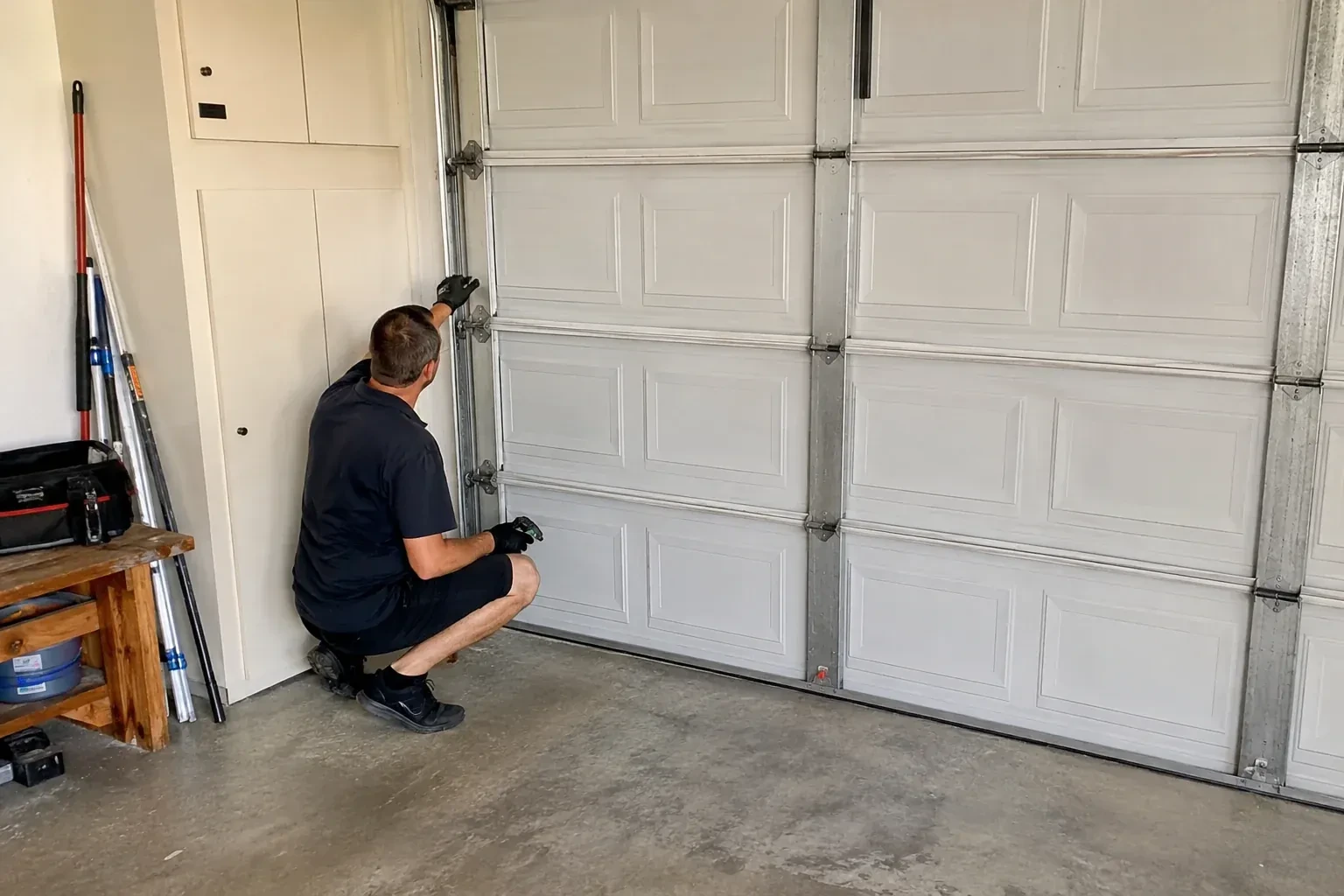
The moving metal-on-metal points get a light coat: the spring coils, the hinge knuckles, the roller bearings and the pins at the bottom brackets. A silicone or lithium product made for doors is used, then the door cycles a few times to carry it in. The tracks are the exception; they are cleaned and left bare, since a slick track lets the wheels skid and holds grit against them.
What kind of doors and openers do you service?
Residential sectional doors of every common construction: steel, insulated steel, aluminum and glass, wood and composite, single and double width, with torsion springs above the header or extension springs beside the horizontal tracks. Openers of all the usual types are covered too, including chain drive, belt drive, screw drive and wall-mounted jackshaft units. If the door is a one-piece tilt-up or a commercial rolling door, mention that when booking so the right hardware comes along.
My door has springs along the sides, not above it. Is the reset the same?
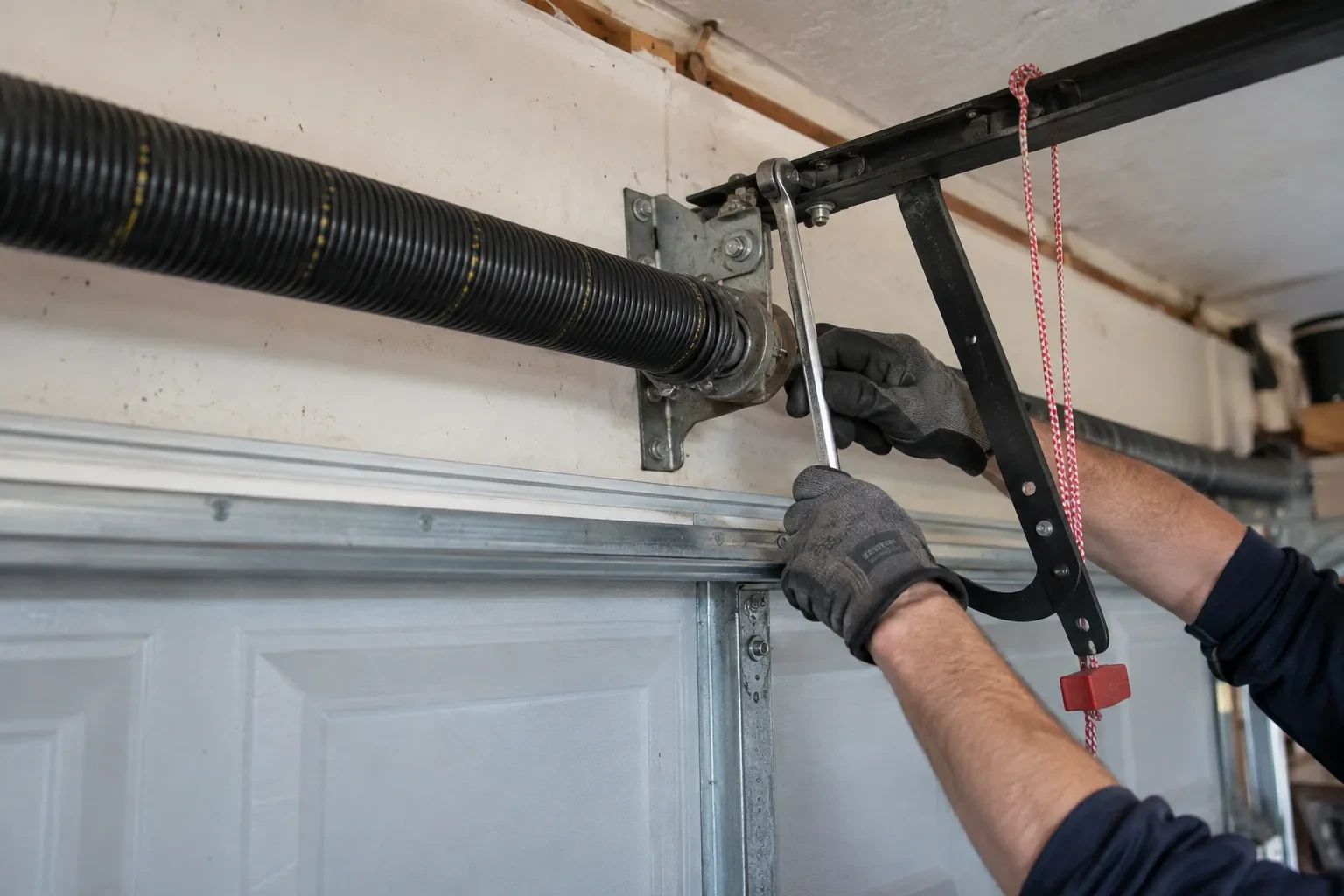
The principle is the same but the sequence differs. With side springs the door is first opened all the way and clamped, because that is the position where the springs carry no load; the cables are then checked over their pulleys and evened up at the clips. The technician also checks that a containment cable runs through each spring, which stops a broken spring flying across the garage, and fits one if it is missing.
How do I know whether the damage is only cosmetic?
Watch the door move. A cosmetic dent leaves the section flat at the joints, the door travelling without a catch, and the hinges and rollers seated normally. Signs that the damage goes further include a crease that reaches a joint or stile, a hinge screw that has pulled out, a roller sitting crooked in the track, a gap of daylight at a joint, or a shudder as that section reaches the track curve. Any of those calls for a proper assessment.
Should I choose the tallest seal available?
Not as a rule. The seal should fill the measured gap with a little compression to spare. A profile far taller than the gap gets squashed flat, wears at the fold, bows the bottom section and can make the opener reverse. Where the floor dips at one end, a taller bulb is the right call for that door; where the floor is flat, a standard height lasts longer. Measuring first is what settles it.
What colours does perimeter weatherstrip come in?
Standard ranges cover white, almond, brown, grey, black and a sandstone or clay tone, which between them match most trim, garage door and brickmould colours. The technician brings the colour that suits your trim once you describe it or send a photo. A one-piece vinyl stop is coloured through, so it does not show scratches, and a fin on a painted wood stop can be matched to the paint.
What kinds of manual locks are found on garage doors?
Two are common on sectional doors. An inside slide bolt sits on the door's edge and shoots sideways into a slot in the vertical track; some are spring-loaded snap latches that lock on their own when the door closes. An outside keyed T-handle turns a centre mechanism that throws a bar into each track, though some models pull a cable to release a spring latch instead. Some doors add a keyed cylinder on the side to work the slide bolt from outside.
Should the track be lubricated too?
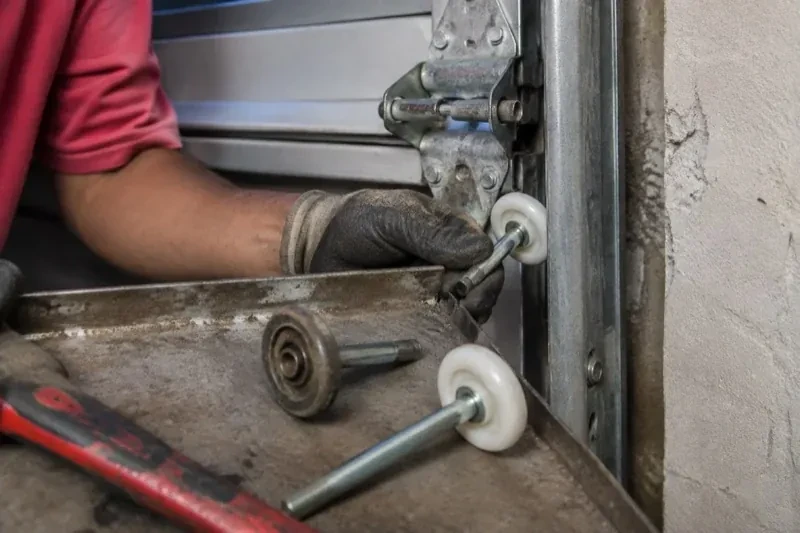
No. The track is meant to be clean and dry so the wheels roll rather than slide. Grease or spray in the raceway collects dust, sand and, in winter, salt and slush, forming a paste that grinds the wheels and can let a roller skid instead of turn. The technician cleans the track and leaves it dry; at home, a wipe with a cloth and an occasional sweep of the bottom few inches is all the track wants.
How long do garage door hinges last?
Many hinges last the life of the door. Those that fail early are usually on doors that were out of balance, had seized rollers, saw heavy daily use, or sat in slush and salt through many winters. A light hinge on a heavy door also wears sooner. Rather than a fixed number of years, watch for cracks near the holes, a rocking pin, rust at the knuckle and screws backing out.
How often should the track and its fasteners be checked?
A glance each month from inside the garage, with the door closed, is enough to catch a bracket standing off the jamb or a hanger starting to lean. Twice a year, snug the bracket bolts and lag screws, wipe out the channel, and watch the door make a full trip to confirm every roller stays in the track. The industry guidance also suggests an annual visit by a trained door technician, who checks the track with the rest of the system.
What are garage door cables made of?
They are galvanized aircraft-type wire rope: many fine steel wires twisted into strands, and the strands laid around a core, which gives a cable that bends around a small drum thousands of times without fatiguing. One end carries a swaged stop or a loop for the drum, the other a loop that fits over the bottom bracket pin. Diameter and length are chosen for the door's weight and height.
Can extension springs be converted to a torsion system?
In many garages, yes. A conversion adds a shaft, centre and end bearings, drums and torsion springs above the opening and removes the extension springs and pulleys from beside the tracks. It needs enough headroom above the door for the shaft and solid framing for the centre bracket. The technician measures the space and the door before recommending it, and the result is smoother, more even lifting with hardware kept clear of the sides.
I added insulation and windows to the door. Does that affect the springs?
Yes, and it is one of the more common reasons a pair of springs is suddenly found wanting. Insulation panels, glazed sections, a wood overlay or a new steel skin all add weight the original springs were never chosen for, so the door grows heavy and the opener strains. When the springs are replaced, the door is weighed as it is now, and the new pair is rated for the door you actually have.
What safety tests are done after the adjustment?
Two are standard. A piece of two-by-four is laid flat on the floor in the door's path and the door closed onto it; it must reverse and return to open. Then, as the door closes, an object is passed through the photo-eye beam near the floor, and again the door must reverse. Both depend on a balanced door, which is why they come after the adjustment rather than before.
Should I lubricate the chain, the rail or the track?
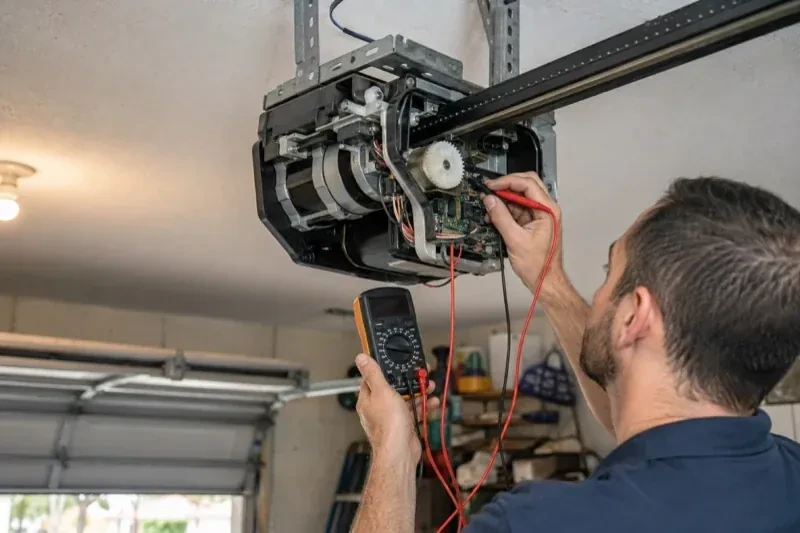
Rollers, hinges, bearings and springs benefit from a garage door lubricant once or twice a year. The chain, belt or screw-drive rail is a separate question, since each drive type calls for its own product and schedule from the opener's manual rather than one rule for every unit. The track itself should stay clean and dry, because lubricant there collects grit and makes rollers slide instead of turning. The technician can point out the spots on your door at the end of the visit.
Why does the door touch the floor and then go back up?
The operator believes it has hit something. Either the down travel limit is set a little too far, so the door is pressing into the floor past its stopping point, or the closing force is set too low for the door's current weight, so the last push reads as an obstruction. A seal frozen to the slab causes the same reversal in winter. The technician adjusts the limit or the force, in that order, and re-tests the reversal afterwards.
What should I do in the garage before the technician arrives?
Park the cars outside and leave the floor beneath the rail and the door's path open so a stepladder can be set at either end. Lift bicycles and boxes off hooks near the rail. Keep the remotes and wall control within reach and know where the operator plugs in. If the door is stuck closed with a car inside, mention it when booking.
Will the new opener cope with an unheated garage in winter?
Yes, when it is chosen for it. Manufacturers publish an operating temperature range for each model, and the technician matches that to a detached or unheated garage. The force setting is tuned so the door moves in the cold without the operator being oversensitive, the hardware gets a cold-rated lubricant, and a backup battery is kept charged by the unit. Clearing ice from the threshold remains the one winter chore.
How should I clean the lenses?
Gently, with a soft dry or lightly damp cloth, the way you would clean eyeglasses. Never scrape a lens or use a solvent, since a scratched or clouded lens scatters the beam. Wipe both sensors, then check that the receiving light comes on steadily. If a lens frosts on cold mornings, give it a few minutes to clear or dry it with a cloth. A quarterly wipe keeps dust, cobwebs and salt film from building up.
Why does my remote work only when I am right under the door?
Short range is a signal problem, not a pairing problem. LED bulbs in the opener's own sockets can emit radio noise that swamps the receiver, an antenna wire tucked into the housing cannot hear well, and a coin cell near the end of its life transmits weakly before it dies. Swapping the bulb, letting the antenna hang free and fitting a fresh cell usually restore range; if not, the receiver is checked.
How long does the setup take?
A built-in radio that only needs pairing and an account is the shorter visit. A retrofit hub with wiring, a sensor and network work takes longer, and adding an access point for a detached garage or correcting photo eyes first adds to it. The testing at the end, every control plus the safety tests, is never rushed. You are told where things stand once the compatibility check is done.
How long does an emergency release repair take?
A cord and handle, a lever spring or a trolley freed from the stop bolt is a modest part of an hour, including the balance test and reversal tests. Replacing a trolley or fitting an outside key release takes longer, since the drive is slackened and re-tensioned or a hole is cut in the door. If the balance test finds the springs need work first, that is a separate piece of the visit, and you are told before it starts.
Which insulation details should I compare?
Look beyond a single thermal number. Compare section construction, insulation type and thickness, seals between panels, glazing and the perimeter weather seals included in the proposal. How often the door opens and how well it fits the floor also influence comfort. Product literature provides the appropriate performance information for the exact model.
How should painted steel sections be cleaned?
Use the care method provided for the selected finish. Common guidance involves mild soap, clean water and a soft cloth or sponge, followed by a thorough rinse. Work on a cool surface and avoid abrasive pads that can mark the coating. Seasonal washing removes road film and winter residue while giving you a chance to notice scratches, seal wear or developing corrosion.
Will a reinforced door be heavier than my old one?
It may be. Added struts, different section construction, glazing, and heavier hardware can change the total door weight. The counterbalance springs are selected for the finished assembly, and the opener is checked for compatibility and correct attachment. With proper balance, the door should still move in a controlled way by hand and under power.
Can the opening be widened for a larger door?
A wider opening can be a separate renovation project, but it requires more than changing the door order. The header, side framing, exterior finish, electrical items and supporting loads need appropriate review, along with any permit or design requirements. Once that work has defined and prepared the final opening, the carriage-house door can be measured and specified against stable dimensions.
What should I move before the installation visit?
Clear vehicles, bicycles, shelving on wheels and stored items from the door path and the areas beside the tracks. The crew also needs an unobstructed route for glazed sections and a clean staging space on padded supports. Mention fixed cabinets, ceiling storage, vehicle lifts or delicate flooring early so protection and handling can be planned around them.
How are high-tension parts handled during installation?
The door is secured against movement while trained installers mount the spring supports, lift cables and related hardware. Correct winding or tensioning tools are used for the specified counterbalance system, and cable routing is checked before the door is released for testing. Bottom brackets and spring attachments stay under controlled handling because they carry load. The area remains clear until balance and travel have been assessed through the full opening path.
Can corrosion on lower hardware be repaired?
Surface condition and remaining material determine the scope. Light contamination may be cleaned during maintenance, while pitted cables, weakened brackets, seized rollers or compromised fasteners are replaced with compatible components. The source of moisture is considered too. Clearing drainage, renewing seals and removing accumulated salt help protect the repaired lower section and its hardware.
Can guide damage be straightened instead of replaced?
Some local bends can be corrected when the guide retains its strength, fastening points and required profile. Creased, torn, heavily corroded or repeatedly struck sections may call for compatible replacement. The choice also depends on guide gap, endlock or windlock arrangement, mounting construction and whether the door is part of a labelled fire-protection assembly.
How much ceiling height does the conversion need?
There is no single ceiling figure because the useful dimension depends on the opening height, desired clearance, track transition, shaft and spring space, opener arrangement and nearby obstructions. A technician measures the whole bay and calculates the high-lift rise that fits those boundaries. The result should be expressed as a proposed open-door clearance before the component set is ordered.